Thursday, 24 January 2019

Things in the library 25 Jan...

Things about Prof Illingworth (our namesake)...
We had an email this week from Kate Statham (Communications/Events Co-ordinator at Western Bank Library) she said this:

I work for The University Library at The University of Sheffield and I am currently involved with organising The Sheffield Authors Showcase, which celebrates publications by some of the universities leading academics.
As part of this, we are filming a short documentary on the following book -  Ronald Illingworth: The Normal Child
I am looking for interviewees, who have read this book or have some interest in this subject/Ronald Illingworth. 
If you would like to help Kate please email her

Things for keeping quiet...

If you are studying or working in the library and do not want distractions, please request our ‘Do Not Disturb’ notice. Place it on the back of your chair or on the desk and it’s clear to others that you are here to work.


Things not to keep quiet...
There is still time to sign-up for our next conversation opportunity in February's Randomised Coffee Trial.
Thank you to all of those who have already signed up i will be matching next week so click on the link to find out more.

Things that might confuse you...
The National Library of Medicine (whose classification system we use) has recently overhauled the paediatric numbers it uses. This is actually a great improvement as now more of the paediatric books will be close together and subjects like childhood asthma and obesity have new numbers in the paediatrics section of the library (books with spine labels beginning WS)

We are gradually moving these books around and relabelling them so if you go to the shelf for a favourite book and it isn't there please ask library staff to help you or search our library catalogue for the new number.

Even if the books you use haven't been given new numbers you may find they have moved several shelves to the left in order to make room for some of the others...we are sorry about this as we know how irritating it is when supermarkets change where things are kept...but you never know you might just stumble across something interesting which you wouldn't have otherwise found.

Things about inpatient mental healthcare...
From Young Minds website there is a useful set of resources aimed at young people about what happens in a mental health unit if they are an inpatient.

Things to access and read...

People sometimes forget we have e-books available to you via your NHS Athens login. They can all be found via our library catalogue. The most used titles at the moment are:

  • Training in Paediatrics
  • Lovell and Winter's Pediatric Orthopaedics
  • Operative Pediatric Surgery
  • Anxiety in Children and Adolescents with Autism Spectrum Disorder : Evidence-Based Assessment and Treatment
  • Essentials of Audiology
If there are books which you think would be useful as e-books for you or your team please contact us and we can consider buying them.

Things to attend...
These three courses from ScHARR are available to book

Systematic Reviews and Meta-analysis  
3 day course:  Tuesday, 26th - Thursday, 28th March 2019
The Early Bird Rate for this course will automatically close at 11pm on Sunday, 27th January 2019 Here is the  link to the full course information, including fees:

How to Quickly Synthesise Research 
1 day course:  Tuesday, 12th February 2019
Bookings for this course will automatically close at 11pm on Wednesday, 29th January 2019. Here is the link to the full course information, including fees:

Utility Data for Health Technology Assessment  
2 day course:  Monday, 11th - Tuesday, 12th March 2019
Bookings for this course will close automatically at 11pm on Monday, 25th February 2019 Here is the  link to the full course information, including fees:

Things about child health...
This report from RCPCH on 'State of Child health: England - two years on'  congratulates the Government on its commitment to child health, commending them on bold pledges in areas such as obesity, mental health and the integration of children’s health services. However, the scorecard also reveals that England continues to lag behind other Western European countries on a range of child health outcomes and notes areas for improvement, particularly in universal public health provision, including: reducing child poverty and inequality; child deaths; tobacco and alcohol control and breastfeeding.

Things to make...
A recipe from Kate this week for Peanut butter chicken...apparently yesterday was Peanut Butter Day!


Friday, 18 January 2019

Things in the library 18th Jan...

Things about obesity... 

The dept of health & Social Care have published 'Childhood obesity, a plan for action: a consideration of interactions between modelled policies'. Setting out how the policies in chapters 1 and 2 of the government’s childhood obesity plan could work together.


Things about the NHS long-term plan...
The King's Fund have published their response to the NHS long term plan. They state that "The new NHS long-term plan includes a number of commitments which – if delivered – will improve the lives of many people. But some significant pieces of the jigsaw are still missing, and there should be no illusions about the scale of the challenge ahead"

Things about mental health...
The House of Commons published 'Mental health services for children and young people'
The summary is:
In 2017–18 only three in ten children and young people with a mental health condition received NHS-funded treatment, and many more faced unacceptably long waits for treatment. The government has committed to providing ‘parity of esteem’ between mental and physical health services, but it is still unclear what it means by this in practice. It also has no comprehensive, long-term plan for how it will fulfil its commitment to implement Future in Mind, which set out a cross-sector vision for how to support children and young people’s mental health. There is now a welcome focus on improving NHS mental health services for children and young people, but there are still significant gaps in the data to monitor progress. Recently published figures have underlined the scale of the task faced: one in eight (12.8%) five to 19 year olds have a mental health disorder. There has also been a marked increase in the number of five to 15 year olds who suffer from an emotional disorder: the figure now stands at 5.8% in comparison to 3.9% in 2004. Work to increase mental health staff numbers and develop the right skills has also progressed more slowly than planned. The recurring issues with recruitment and retention of NHS staff remain unchanged and it is clear that the government’s inability to increase the number of mental health nurses is a roadblock to progress in this area. New and important ways of supporting young people’s mental health through prevention and early intervention, particularly in schools, are now being developed. The government must make urgent headway on all these fronts if it is to provide the mental health services and support that young people need.'
Things about hearing...
Hundreds more people with severe to profound deafness are expected to be eligible for cochlear implants each year, due to updated NICE guidance.The update comes after a review of the definition of severe to profound deafness which is used to identify if a cochlear implant might be appropriate.

Things about Sheffield...
Coming to the Crucible theatre in March/April is 'Standing at the Sky's Edge' this is set in 1961, when the first residents of Park Hill were given the keys to their new homes. With music by Richard Hawley, Standing at the Sky’s Edge tells their story over the next 50 years, in a heart-swelling, heart-breaking love song to Sheffield.

Things to eat..
Sarah received a book for Christmas about what to eat when. One suggestion is eating left over dinner for breakfast e.g. stir fry!  Another is to have something like a frittata. She will be trying this 5 ingredient version this weekend.


Friday, 11 January 2019

Things in the library 11 Jan...

Things happening around SCH...

Our previous Randomised Coffee Trial in November was a great success with most people, so we have decided to keep running RCTs probably 3 or 4 times a year. The sign up form for the next one is now available and we will be encouraging you to meet with your new partner during February. Please open the form link in Chrome or Firefox  to sign up. This time, if you wish, you can select to stay on our 'matching' list for all future RCTs (until you tell us to remove you) so that you don't have to sign up each time.

Things too sugary...
Children have already exceeded the maximum recommended sugar intake for an 18 year old by the time they reach their tenth birthday, according to Public Health England (PHE). This is based on their total sugar consumption from the age of 2. This figure comes as a new Change4Life campaign launches, supporting families to cut back on sugar and to help tackle growing rates of childhood obesity.

While children’s sugar intakes have declined slightly in recent years, they are still consuming around 8 excess sugar cubes each day, equivalent to around 2,800 excess sugar cubes per year. To help parents manage this, Change4Life is encouraging them to ‘Make a swap when you next shop’. Making simple everyday swaps can reduce children’s sugar intake from some products (yoghurts, drinks and breakfast cereals) by half – while giving them healthier versions of the foods and drinks they enjoy.

Things to attend...
Journal Club next week 15th January 13:00 to 14:00 in the Education and Skills Centre, F Floor, Stephenson Wing.discussing "Estimating risk of pneumonia in a prospective emergency department cohort" muffins will be provided and Journal Club is open to all health professionals. It is a fun, informal way of learning to criticise papers and gather evidence to change practice.
At each meeting a speaker presents a critical appraisal of a research paper, using a recognised appraisal tool such as CASP Group members then have an informal discussion to determine whether or not current practice should be altered in light of the presenter's findings

Things about safeguarding...
The National Children’s Bureau has published "Safeguarding early adopters: developing the learning on multi-agency safeguarding arrangements interim report – December 2018".  This report shares the emerging learning from the Safeguarding Early Adopters (EA) programme including activity from the programme so far; approaches the EA projects are testing and implementing; early principles for implementation; and learning examples from EA projects.

Things about single parent families...
The experience of single parenthood is more common than typically reported – and children’s wellbeing is not negatively affected by living in single parent households – according to a study led by the University of Sheffield. A report by Sumi Rabindrakumar, in her role as policy officer at the leading national charity working with single parent families, Gingerbread, and University of Sheffield researchers, found that public policy and research needs a more nuanced understanding of single parent family life – reflecting how households change over time.The study, carried out as part of the University’s Crook Public Service Fellowship scheme, explored the experiences of more than 27,800 households with children over a six-year period.

It found that, while surveys typically suggest that one in four families with children are headed by a single parent at any one point in time, data suggests that one in three families with children will have been a single parent family at some point over a six-year period.

Things about food insecurity...
Nearly one in five UK children under 15 lives in a home where the parents cannot afford to put food on the table, the environmental audit committee has said. The committee’s report, Hunger, Malnutrition and Food Insecurity in the UK,1 says that about 19% of under 15s live with an adult who is moderately or severely food insecure, defined as having “limited access to food . . . due to lack of money or other resources.” Of these, half are severely food insecure. The Food Foundation told the committee that this makes the UK “one of, if not the, worst performing nations in the European Union.”

Things that are useful...
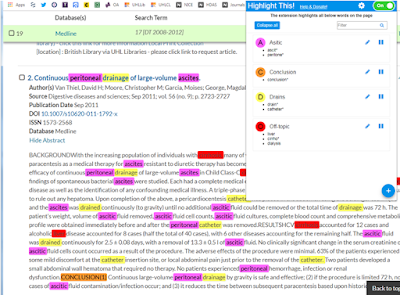
Pinched from another health library's blog this week (University Hospitals of Leicester) is a useful article about highlighting multiple words at once in Chrome.


Things to buy...
We have some old editions of books available for sale - first come first served....please check out the trolley in the library or click this link to view the list . If you are registered with the library we can save items for you and we will add the the cost of them to your library account...please note this is a commitment to buy...we will not reserve items for you to look at and then decide you don't want to buy.


Things to read...
Our next reading group meeting will be on Wed Feb 6th at 17:15 with drinks and nibbles provided. The book to read if you have time is 'The Choice' by Edith Eger. Dr Eger shares her experience of the Holocaust and the remarkable stories of those she has helped ever since. Today, she is an internationally acclaimed psychologist whose patients include survivors of abuse and soldiers suffering from PTSD.
 'The Choice is a gift to humanity. One of those rare and eternal stories that you don't want to end and that leave you forever changed.'"- Desmond Tutu , Nobel Peace Prize Laureate

Things to eat...
This Honeyed winter salad is easy to make and served warm.


Friday, 4 January 2019

Things in the library 4th Jan...

Happy New Year to you all

Things to attend...
Our excellent Critical Appraisal course is running again on Thurs 31st Jan from 9:00 - 13:00. No prior knowledge of the subject is required and you will learn the basics of how to critically read an article and judge its value in a small group. If you are interested please sign up for this training via the SCH intranet as soon as possible.

Things about screentime...
A study of the effects of screentime on children and young people (CYP) is in the news today. The systematic review it comes from concludes:
"There is considerable evidence that higher levels of screentime is associated with a variety of health harms for CYP, with evidence strongest for adiposity, unhealthy diet, depressive symptoms and quality of life. Evidence for impact on other health outcomes is largely weak or absent. We found no consistent evidence of health benefits from screentime. While evidence for a threshold to guide policy on CYP screentime exposure was very limited, there is weak evidence that small amounts of daily screen use is not harmful and may have some benefits.
These data broadly support policy action to limit screen use by CYP because of evidence of health harms across a broad range of domains of physical and mental health. We did not identify a threshold for safe screen use, although we note there was weak evidence for a threshold of 2 hours daily screentime for the associations with depressive symptoms and with HRQOL. We did not identify evidence supporting differential thresholds for younger children or adolescents.
Any potential limits on screentime must be considered in the light of a lack of understanding of the impact of the content or contexts of digital screen use. Given the rapid increase in screen use by CYP internationally over the past decade, particularly for new content areas such as social media, further research is urgently needed to understand the impact of the contexts and content of screen use on CYP health and well-being, particularly in relationship to mobile digital devices."

and also... 
The RCPCH issued guidance today on the health effects of screentime for children. The guide provides a summary of existing research on the health effects of screen time on children and young people. It outlines recommendations for health professionals and families on screen time use. Their primary recommendation is:
 "that families should negotiate screen time limits with their children based upon the needs of an individual child, the ways in which screens are used and the degree to which use of screens appears to displace (or not) physical and social activities and sleep. We would also adopt the expert recommendation that screens are avoided for an hour before the planned bedtime."
Things about refugees...
The World Health Organisation has recently published technical guidance on the health of refugee and migrant children. Policy considerations include an intersectoral approach to promote good health and well-being, particularly mental health, in migrant children that target risk factors at the individual, family and community levels. Particular emphasis is placed on how national/local governments have an important role in fostering or hindering living conditions for refugee and migrant children in the areas of housing, health care services and education.

Things about cancer...
The Healthcare Quality Improvement Policy produced a report in December 'Cancer in Children, Teens and Young Adults'. This report deliberately focuses on a sample of patients who were a high-risk group who died or who had an unexpected admission to intensive care. The rationale being that this is where care-planning, service provision and communication should excel. Any remediable factors in care for this group would benefit all children, teenagers and young adults receiving SACT( systemic anti-cancer therapy). The report can be downloaded from this page.

Things to read...

Our Reading group is next week (normally the first Wednesday of the month) I have enjoyed both our Christmas read choices and they are available to borrow from the library if you wish to read them. The meeting next week is at 17:15, drinks and nibbles provided and if one of your New Year resolutions was to read more do come and join us...it doesn't matter if you haven't read the book! Both books feature an American Northern Cardinal bird on the cover (despite one of the stories being set in Ukraine).

Things about Christmas trees...

If you didn't get chance to book a collection for your real Christmas Tree in aid of SCH charity then you can take it along to University of Sheffield Information Commons car park tomorrow  Sat 5th Jan from 8am to 3pm where it will be chipped and used on the campus as a mulch during the year.


Things to make...
Not to eat this week...we have all done a lot of eating recently...but some creative ideas for recycling your Christmas cards rather than putting them in your (probably) overfull blue bin.


Things coming soon...
After the success of our recent Randomised Coffee Trial will will be organising another one soon...


Friday, 21 December 2018

Thing is the library 21 Dec...

Merry Christmas & Happy New Year

Things about our Randomised Coffee Trial...
Thank you to everyone (104 people) who took part - these are the results of the feedback. If you didn't take part in November 2018 watch out for our next one when it is announced.
96% said it was a positive experience and they would probably take part again
88%  said they learnt something new
78% said it widened their professional network

"It was a great idea, a really great way to meet new people"
"It's always good to talk!"
"I learnt a lot about SCH that I didn't know as we work in such different areas."
"We had a lovely chat for around 40 minutes and I loved every minute!"
"It was only half an hour and tricky to co-ordinate but it felt that it was a real luxury to step outside the workplace"
"we pass people on corridors but have no idea who they are / what they do"

We had a good range of staff taking part too.


Thank you all - I have had such positive feedback that I would certainly like to make this a regular event - something that becomes part of the SCH culture. 

Things about headaches...
Headache disorders are common in children and adolescents. Most of the studies on non-pharmacological treatments have however been carried out on adults. In this review they provide information on recent studies examining non-pharmacological approaches for managing headache in children and adolescents.

Things about milk cereal drinks...
This Swedish study looked at the association between daily consumption of  milk cereal drinks at 12 months of age and BMI at the age of five. The main finding of this study was that the daily consumption of milk cereal drinks at 12 months of age was independently associated with almost double the risk of a child being overweight at five years of age. A family history of obesity, low paternal educational level and paternal smoking were also independently associated. 

Chicken wrapped in bacon with potatoes and beansThings to make...
We love eating up 'left-overs' in our house and nothing on the turkey gets wasted - it is eaten cold in sandwiches, in fricassee and curry and then eventually stock and soup with the carcass - which you can freeze. If you want inspiration for using up other gluts of food then there is a nice selection of ideas here. 

Things to return (hopefully not!) ...
image_of_open_fire_treeIf you haven't come across Resolver for helping sort out complaints I can recommend it. They have also produced a helpful list showing the extended holiday returns policies of UK retailers....so if Father Christmas delivers something in the wrong size or colour this might help!

We close today at 5 pm and re-open on Wed 2nd January, whether you are working or on holiday we hope you all have a great time.

Friday, 14 December 2018

Things in the library 14 Dec....

Things closed...
On Tuesday 18th December we will be closed all day as it is our "dust creating and pre-Christmas workout" day...otherwise known as Stocktaking Day. If you need to return books please use the book drop box situated outside the library and emails will be dealt with the following day.

Things about food allergies...
The aim of this review article in Nutrients is to summarise randomised studies that have investigated whether there is a time window for the early introduction of allergenic foods (both in infants at high-risk for atopy and in the general population) that could effectively prevent food allergy, ascertained by the diagnostic oral food challenge test. They conclude that  "In practice, during the first year of life, the child can progressively be introduced to all foods, according to his/her requirements and the ability to chew, keep head still and sit propped up. Allergenic foods that may be inhaled (i.e., nuts) because of immature oral motor skills, should be avoided or given in a form that is safe for infants, such as peanut butter."

For infants with food allergy and/or severe eczema "an oral food challenge under medical supervision, before introducing the food into the diet, should be considered. This should be taken into account not only for egg and peanut, but also for the other foods, including cow’s milk, tree nuts and seeds, which contain allergens resistant to heat, pH and enzymatic digestion and capable of sensitization via the oral route"

Things about poverty...
The Joseph Rowntree Foundation have published their Poverty UK 2018  report. The research focuses particularly on changes to poverty among children and workers, as well as giving an overview of trends among pensioners and other groups. This research reveals that, in our society:

  • Child poverty has been rising since 2011/12; 4.1 million children are living in poverty, a rise of 500,000 in the last five years; 
  • Four million workers are living in poverty –a rise of more than half a million over five years; and 
  • In-work poverty has been rising even faster than employment, driven almost entirely by increasing poverty among working parents. 

Things new...

A new selection of books has just arrived and will be available to borrow in the New Year. If there is something you fancy then by logging in to our online catalogue with your library reader number and PIN (ask us if you don't have one) you can reserve them - or contact the library.

Things to make...
Queen of puddingsAn old fashioned but lovely easy pudding I am making this weekend is 'Queen of Puddings'. I'm making mine from my mothers 1950's version of Good Housekeeping (which also includes instructions on managing kitchen staff!). This recipe from Mary Berry is virtually the same although the meringue never gets piped in our house ...just dolloped on top..and the jam (raspberry) has been known to come out of a jar!

Friday, 7 December 2018

Things in the library 7th Dec...

Things to read next year...
We had our reading Group Christmas party this week and spent most of the time choosing our reading for next year. If you have ever fancied joining us on (usually) the first Wed of every month at 17:15 in the library then please give us a try next year. We just chat about the book we have been reading and there are always drinks and nibbles available. Over Christmas we will be reading either (or both) of these: The night before Christmas by Nikolai Gogol or A Redbird Christmas by Fannie Flagg and discussing them at our meeting on January 9th (not the first Wednesday).

The books for the rest of the year are:
6th  Feb:  The Choice: Embrace the Possible by Edith Eger
6th Mar:  Murder of my aunt by Richard Hull
3rd Apr:  This is going to hurt: Secret diaries of a junior doctor by Adam Kay 
1st May:  Hold My Hand by M.J.Ford
5th Jun:  Mythos: The Greek Myths Retold by Stephen Fry 
3rd  Jul:  Spark of Light by Jodi Picoult 
7th Aug: The Librarian by Salley Vickers
4th Sep: tbc
2nd Oct:  Penguin Book of the Contemporary British Short Story   Philip Hensher (Ed.) (2018):
6th Nov:  The Seven Deaths of Evelyn Hardcastle by Stuart Turton

Things about health in England...

The Health Survey for England (HSE) monitors trends in the nation’s health and care. It provides information about adults aged 16 and over, and children aged 0 to 15, living in private households in England. The survey is used to monitor overweight and obesity and to estimate the proportion of people in England who have certain health conditions and the prevalence of risk factors and health related behaviours, such as smoking and drinking alcohol.
The survey consists of an interview, followed by a visit from a nurse who takes some measurements and blood and saliva samples. Adults and children aged 13 to 15 were interviewed in person, and parents of children aged 0 to 12 answered on behalf of their children for many topics. Children aged 8 to 15 filled in a self-completion booklet about their drinking and smoking behaviour.
There are various summaries available online - one of the key facts is that only 18% of children had the recommended 5+ portions of fruit and veg daily

Some things West African...


At The Workstation, on 13 Dec The University of Sheffield and Zongo Music present The Calabash: A celebration of West African film, live music, art and culture. Free entry but you can register in advance
7pm: African Bazaar - traditional African wares on sale. Bar opens.
8pm: Join Dr Afua Twum-Danso Imoh (School of Sociological Studies) in the premiere of her documentary film, 'Growing up colonial on the Gold Coast (Ghana)'shot in Ghana, West Africa to explore her British Academy-funded research into a 'proper' childhood for colonised subjects in the Gold Coast. Includes Q&A.
8.30pm onwards: Live acoustic music and DJ set and Spoken Word and Poetry

Things about future health...
From the Health Foundation a report A Place to Grow: Exploring the future health of young people in five sites across the UK. the key points are below.

  •  In five UK towns and cities, the Young People’s Future Health Inquiry team listened to the perspectives of young people and youth organisations about access to the assets needed for a healthy transition into adulthood.
  • Our visits uncovered common themes and a strong sense of place, shaping the young people’s identity and how they described themselves. 
  • But young people’s access to the opportunities and relationships that can ensure a healthy future varies across the UK.
  • Young people are profoundly affected by the nature of their local economy, housing and labour markets, and by the strength of the social fabric around them
Things about loneliness...
Office for National StatisticsFrom the Office of National Statistics a report on Children’s and young people’s experiences of loneliness: 2018. This analysis of children's and young people’s views, experiences and suggestions to overcome loneliness, using in-depth interviews, the Community Life Survey 2016 to 2017 and Good Childhood Index Survey, 2018.

Things to eat...
I can't comment on its authenticity but this Spicy African stew should definitely warm you up this weekend.